Showing posts with label recommendations. Show all posts

Friday, 19 December 2014

Falling in love with Fiji: Barefoot Island.

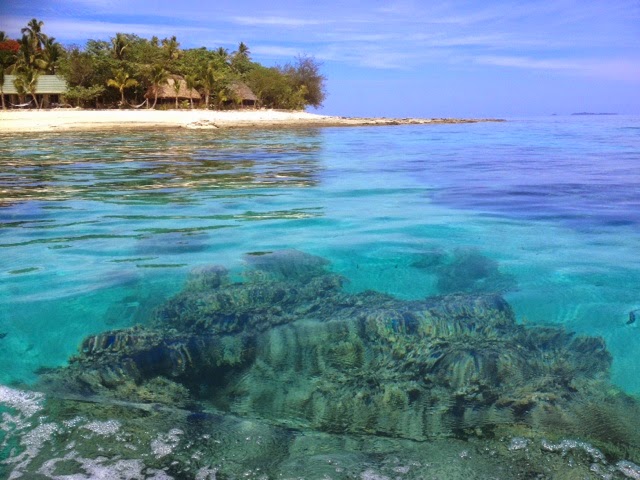
Just three hours on the Yasawa Flyer, and you'll find yourself stepping onto the beautiful Barefoot Island to the soundtrack of the traditional Fijian 'welcome song'. Barefoot Island is everything you imagine Fiji to be: deserted white sandy beaches, clear turquoise seas, coral abundant with fish ever colour of the rainbow and sunshine. Lots and lots of sunshine.


Barefoot Island has two beaches about 100 metres apart: sunrise and sunset. This means you can follow the sun throughout the day, watching it rise over the horizon on one side of the island, and drink sundowners in the beach bar as you see it dip down the other side of paradise.

Accommodation
We stayed in a 4 bed 'bure' right on the beach. Clean, comfortable and private, it was pretty perfect. Cracks in the shutters gave us views over sunrise beach, and the cooling evening winds kept the mossys away. Toilets and showers were just across the path but were well lit in the evenings and hot water was available 24/7.


Food
Fresh fruit, pancakes and coffee are on the menu every morning in the simple continental breakfast  buffet. At lunch you'll sit down to a pasta based meal, that's pretty bloody tasty but a little carb-heavy for mid-day; request gluten free if you struggle like us. The evenings were the culinary highlight, with a three course, al-a-carte meal served every night in the beachside restaurant.


Soup to start, then mains including chicken curry and beef stir-fry. For afters there is always cake, and who doesn't love cake. Happy hours take place every day from 6pm, and you can get afternoon tea (which is literally just tea and coffee) at 4pm in the restaurant every day.

Activities
The staff on Barefoot Island were literally the friendlies people I've ever met; always bending over backwards to help and so keen to make sure everyone is having the best time. Barefoot is small though, so activities are limited, but the island runs a programme every day so there is always something to do.


The snorkelling was top notch. Hire your equipment from the shop for $5 per half-day and swim from one beach, round the headland, to the other side. It's beautiful.
A brief 20 minute hike into the island's jungle and you'll find yourself at a pretty impressive viewpoint, overlooking manta ray island opposite.
Every day the dive team offer 'pool splash' opportunities for those that are keen to try out diving but unable to afford the full course.


We got kitted up in all the gear and paddled around in the shallows of the beach for a half an hour; it was great fun. Harder than I thought it would be, and clearly not something that someone with a lung condition should be doing. But, I'm glad we tried it.
Volleyball matches are played every day at 5.30pm, and you can join the sunset tubing if you fancy a drink on the water.


We loved Barefoot; it was where our love affair with Fiji started. The people, the place, the food, it was top-notch and I can't recommend it enough.

Thursday, 11 December 2014

Where to go and what to take to Fiji.

Booking our 8 night trip to Fiji was so much more difficult than we ever imagined it would be. After attempting to organise the trip ourselves, we reached out to one travel agent who seemed to be helping us but wasn't, really, in the end. We finally met an agent we trusted who had been in Fiji the previous month, and after a couple of hours in Happy Travels, Queenstown, were able to plan our trip to paradise. 


Where to go?
Fiji is a tiny country, spread out across hundreds of Islands in the windy Pacific. There's two main airports: Nadi and Suva. Most backpackers and holiday makers fly to Nadi and head to the Mamanuca and Yasawa Islands out of Port Denarau. Each island has a different vibe, offers different accommodation and food and is a different distance from the mainland: Beachcomber is known to be a party island, Manta-ray is awesome for snorkelling, you can shark snorkel off Wayalailai or visit south sea for the day just a half hour out of Nadi.


How to travel?
These Islands are serviced by two catamarans: the Yasawa Flyer with Awesome  Adventures or South Sea Cruises. The only way to get access to the Islands is by buying a Bula Pass through either. 

Options:

Bula Pass.
A bula pass allows you unlimited boat travel between the Islands, starting from 3 days. The longer you're staying, the more you pay. Accommodation can then be booked separately directly with the resort. 
Pros: you have complete control over your accommodation with no ties and can up and down grade, extend and shorten stays as you see fit
Cons: accommodation books fast so you might end up sleeping on a beach with an empty stomach. Also, single nights in resorts can end up costing a lot so research this option extensibly before you  buy.
Bula combo pass.
A bula combo pass works the same as the bula pass, however it also includes your accommodation and food on the Islands.
Pros: everything is paid for (most of the time), and you don't need to worry about booking beds as-hoc. 
Cons: the pass is pretty pricey, so it's a large outgoing. Also, some of the Islands have an additional premium to be paid on departure ($75 on Bounty!) so watch out for that.

Full Monty packages.
These are pre-planned trips varying in length that can be booked through awesome adventures. Everything is included: your accommodation, your food and a load of activities on each island.
Pros: the only thing you need to pay for is booze. 
Cons: there's no freedom; you have to stick to the itinerary, which can mean you miss stops you wanted to make or have to leave somewhere sooner than you'd like. Also, the activities are cheap on the Islands; we were unsure whether you really needed the full Monty package. 


What to take?

- Water is mostly drinkable on the Islands, but can taste really odd and we did hear stories about upset stomachs. You can buy it on the Islands but it's expensive; about $5 a bottle. We might have looked completely ridiculous lugging 6 litres of water each onto the boats and across the Islands, but we didn't go thirsty the whole trip and didn't spend a fortune on water: 6 litres cost a just $6 each on the mainland. 

- Booze. Drinks are the only thing you'll really spend money on while you're on the Islands, apart from activities, so stock up for cheap in land if you're planning to be as intoxicated as we were for the trip. Happy hours are available on each island, but it's worth it.

- Bug spray. You'll be bitten alive on beachcomber, but other Islands vary. Take it, just in case.

- Mask and snorkel. Some Islands offer this for free, but others charge so if you're a keen snorkeller it's worth buying your own. 

- A camera, with a spare battery. You'll want to photograph Fiji to within an inch of it's life. 


Now, relax as hard as you like. 
L, L & A. X

Wednesday, 19 November 2014

The best hostels in New Zealand.

New Zealand is really well set up for backpackers. There's so many hostels to choose from at each stop it's hard to know which are the best bunk beds in town. Fear not, I've done the research and would recommend checking in to the below...

First, some advice:

Wifi isn't free in a lot of new Zealand's hostels, particularly up north. Many of them use pay-to-use networks which require regular top ups which, although can handily by done via your card, really start to add up. We were paying $4 for 24hr access to the Global Gossip network. You can buy a 7 day pass for $12 which I would recommend because you can keep signing in at your next stop.

Key deposits are popular, ranging from $10-20 per key. You can pay on card for these but it's handy to have cash, and I'd advise only taking as many keys as are necessary - we'd get one between the three of us.

Label your food. People stay for weeks in these hostels and really start to make themselves at home. Make sure your stuff doesn't get lost in the fridge by clearly labelling. This'll also ensure your stuff isn't chucked out during the weekly fridge clean.

Where to stay.

Roturua: Rock Solid.
Rock solid is a huge hostel, ideally located in the centre of town just minutes from the bus stop and round the corner from the main restaurant/bar strip. Set across two floors, it boasts a large kitchen, two lounges, communal bathrooms, a DVD room and free wifi. The lounge overlooks an indoor climbing wall below where you'll receive a 20% discount as guests. This place has loads of potential and is set up to be a great hostel, however the atmosphere fell a little flat when we were there. The main reason for my recommendation? Rock solid had the comfiest beds we slept on in our month in NZ. $26 per night, 4-bed dorm communal bathroom.

Taupo: Taupo urban retreat.
The large 16 bed dorm at the Urban Retreat is located in the roof of the wooden chalet-style building. It's social,  in an excellent location, offers $5 chilli every evening, cheap bike hire, a DVD room and free computers in reception. The bar is the cheapest happy hour in town with pitchers of beer for $12 and g&t's for four. Wifi is extra, $4 for 24hours or $12 for a week's pass on global gossip (see above). The staff were really friendly, there's a large garden area for al fresco dinner and a free phone to check the status of our skydive while you're there. $23 per night, 16 bed dorm communal bathroom.


Wellington: Base.
I didn't want to recommend staying at Base, because it's a chain that is everywhere and it's set up reflects that: packages for weekly stays, meals for $3 every night, tours operated from the hostels, fines for drinking in the room etc.etc. But Base was the cheapest place we could find in Wellington and we actually enjoyed our three night stay. Location wise you can't really beat it, as it sits at the end of Courtney Place. Set across five floors, Base attracts long stayers and our three roommates were all staying in the city and looking for work (Craig had been staying in the same bunk for 7 weeks.) Socially though this was one of the better places we stayed; it was buzzy at most hours of the day/night, the kitchen was packed at meal times, there's a bar downstairs with happy hour from 8-10pm and, despite the squeaky beds, it was comfortable and the showers were hot. $23 per night, 4 bed dorm communal bathroom.

Marahau (Abel Tasman): The Barn.
In the summer The Barn is a huge camping and caravaning site, spreading across a number of fields and overlooking the gateway to Abel Tasman National Park. We were there off-season but would still recommend it, despite the slightly inflated pricing. We shared a 4-bed dorm which had recently been renovated. It was clean, warm and comfortable (no bunk beds either!) The large communal area boasts a huge DVD room, a big kitchen and a free phone. Toliets and showers are in outside blocks but were remarkably mosquito-free and the showers were hot. The shop stocks over-priced must-haves for your trip into the park including wine and beers, they also rent camping gear and will help out with booking your trip into the park. There's luggage storage too, for a dollar a day, but the water taxi guys will store this for free so I'd do that... $30 per night, 4 bed dorm communal bathroom.

Nelson: Paradiso.
We were pretty gutted to have only been here for one night. The hostel was probably one of the best we stayed in, and we could have stayed put. The pool and hot tub were definitely part of the attraction, along with free breakfast, free soup at 6pm, free wifi and clean, comfortable rooms. The place had an awesome vibe about it, with spontaneous games of volleyball taking place every now and again and a busy, communal kitchen area. $26 per night, 4 bed dorm en-suite bathroom.

Franz Josef: Chataeu Franz.
We had four nights in Franz Josef and chose Chateau Franz as our temporary home. Sit Cedric's is an independant chain of hostels which are spreading across the South Island. They've got a refreshing approach to hosteling, are fun, affordable and don't have the stingy attitude that the successful, large chains do. Wifi was free, breakfast was also free, soup was served (for free) at 1pm every day accompanied by hot rolls and breads from the bakery. The DVD room is big and busy, the hot tub is open until 9 every day, and over the weekends and during the summer the fire pit is lit and BBQs take place. Benjamin, the manager, has big plans for the place, telling us about climbing walls and extensions. I couldn't really recommend here more. $25 a night, 4 bed en-suite.

Queenstown: Southern Laughter 
We stayed here, and I can't not recommend it because it was perfect for us: great location, affordable, free soup, free wifi, hot showers etc. Having stayed at the other Sir Cedric's hostel in Franz Josef, we were able to secure a good rate for our five night stint. Beds were comfy, kitchen was big and tea was free. There's a great roof terrace which gets sun most of the day too. The only downside is that it's not Nomads and I fear it won't ever be.
$23 per night, 3 bed communal bathroom. 

Queenstown: Nomads
We didn't stay here because it was expensive, and it really is compared to other hostels in town. Thing is, these guys get away with the inflated pricing because it is the best place to stay if you want to see the best of Queenstown. It's based in the centre of town in a modem multi-storey building, and it's where people go and end up extending because they're not ready to leave. 
$30+ per night 

Tuesday, 18 November 2014

Christchurch, South Island, New Zealand.

We cheated in Christchurch and stayed with my dad's oldest friend, Tom, for our two night stay. 


That does mean that in terms of recommendations etc, this blog is pretty light. That said, we did spent a day in the city and were able to take a look at the massive amount of rebuilding work that has taken place since the earthquake in 2012, and the work that is still to be done.

So many people told us we wouldn't like Christchurch. They said it was a soul-less building site. It can't be denied that parts of it did feel eerie; rubble still lines the roads and everywhere restart and rebuild projects are underway. Souvenirs relating to the quake are readily available, museums and exhibitions are open to peruse. 


Re:start mall sits right by the memorial bridge in the centre of town. It's made up of a group of old industrial crates housing boutique clothing shops, souvenir vendors, book stores and independent coffee shops. Go, it's a very cool place. 


Up the road is C1 coffee shop, which backs onto the cinema (you walk through a sliding bookcase.) The coffee is great the brunch looked incredible and you can order a 'burger pod' which is delivered to your table via old pharmaceutical tubing that snakes across the ceiling. 


Akaroa is about 90minutes out is Christchurch by car and takes you over the beautiful Darles Pass. On the way back, take the less scenic route and stop in at the local vineyards along the road. 


We visited The Farm, which boasts, along with an award-winning Pinot, the second oldest building in New Zealand (which closely resembles a cowshed...) 


Our final day in New Zealand was spent at Addington Races in the sunshine. We drank bubbles, snuck in gin and all lost money on horses with silly names. 

It's been an amazing month, full of the highest highs at 15,000ft and the lowest lows in Nelson Hostpital. The country's beauty is unrivalled. It is clean, calm, spacious and there to be explored.


Sun, sea, sand and cocktails are calling though... Fiji here we come. 


Friday, 31 October 2014

Taupo, North Island, New Zealand

The lake at Taupo is as stunning as Pinterest promised, so make sure you give yourself a couple of days to take it all in. 


The best hostel in town? Taupo urban retreat. For $23 a night we got a bed in the 16-bed attic dorm. The place was pretty buzzy with a cheap bar - $4 g&t's at happy hour - bike rental for $20 a half-day, free computers in reception and chilli available every night for just $5. Wifi is extra, $4 for 24hrs access, which isn't ideal but is a common situation in the north island. 


The best places to eat? There's plenty of bars and restaurants right on the water, though you'll pay a premium price for the views. The lake house has a great craft beer menu whilst pub'n'grub serves huge salads for $17.

Pub'n'grub (inticing name..)

Tank is a cheap spot for salads and smoothies, and the pantry is a great rustic style cafe/restaurant.
The McDonalds in Taupo is one of the chains most famous, so make sure you take time to drop by for a cuppa/happy meal/McFlurry. 


Drinking? Taupo Retreat's bar is the cheapest in town, so start there. On a Thursday night the Irish pub, Macgullins, has an open mic night. There's one nightclub in town, which is next door to the base hostel. In fact, if you're looking for a big night, the base hostel isn't a bad place to start. 

Must sees? Make sure you head to Huka falls. The huge waterfall is about 20minutes out of town and is one of the biggest national attractions in the country. 


We rented bikes from Top Gear on the Main Street for $20 for a half-day, and the track to the falls was awesome. It's worth the ride, especially if you're a mountain bike fan. Hard work, but great fun. You can see the falls by boat, too, for $35 if you fancy a different point of view. 


Must dos? Skydiving in Lake Taupo is one of the best things I have ever done. Throwing myself out of a plane has been on my bucket list for as long as I can remember, and it didn't disappoint. 


Taupo skydive pick you up in limousine, sell you a load of additional merchandise in the shape of personalised GoPro films and pictures, kit you out in a jumpsuit and condom hat and load you into a bright pink plane. 


The climb, to 15,000ft, is beautiful. Lake Taupo stretches out beneath you and on a clear day you can see both of the North Island's coastlines. At 8,000ft everyone is given oxygen, which freaked me out slightly, but I was reassured that it was only there as a precautionary measure and to aid people's recollection of the jump when they land. That aside, I was one of the last to jump to ensure that I recieved as much of the good stuff pre-jump as possible. You're instructed to put your legs out of the plane and put your head back. After that, there's no going back.

Freefallin'

I couldn't describe jumping if I tried, nor the minutes freefall that followed, but it was better than I ever imagined it would be and as soon as it was over I wanted to do it again. 

Taking the reins 

In total, with the video (which I'll share when I'm back in blighty), the photos and a t-shirt, the jump cost $439. Yes, it's expensive (£215) but I'd pay it again in a heartbeat. 


I can guarantee it won't be my final flight.

L x 

Monday, 27 October 2014

Auckland, North Island, New Zealand.

We had 6 hours in Auckland between buses, so made plans to see as much of the place as possible.


Britomart, the main train station, has lockers where you can store luggage if required it costs about $10 for the day. They happened to be out of order so we ended up stowing our bags on the ferry dock with a random lady at travel agents for just $5 (barg.)

Queen street is the city's main road, snaking up the hill from the bus stop. There's loads of shops, restaurants and cafés so it's worth having a browse.

If you're looking to save money though (enter us!) head to K-road, which interjects Queens street about 20minutes down. Charity shops and vintage stores are dotted between quirky cafés and eateries offering food from around the globe. This is the hipster part of town, and if left a little bit like being back in London. If vintage is your thing, you'll have found a slice of heaven. I bought a huge cable knit jumper for $25 (£12), Alice grabbed some shorts for $10 and I bartered with a woman to get two spoons for $3 (skills I picked up in India are coming in handy!)

We grabbed lunch at Revels, a quirky café on K-road which gave out free sweets at the till and sold it's own peanut butter. Soup and sourdough toast for $8 made it the same sort of price as home. 


Our final stop was the Skytower, because we are tourists after all. Entry was $20 each, but the view was worth it, especially if you're only here for the day. The city looks quite spectacular 182 metres up. We bought bubbles in the bar to toast our first full day in New Zealand - perfect.  


I'd love to have had a night out in Auckland, it's clearly a pretty cool city. Instead we grabbed some g&t tinnies (6 for $12) and re-boarded the Nakedbus.


Us three. Xx 


Sunday, 19 October 2014

Eating our way around India.

Surviving a month in India without getting Delhi belly is probably one of my greatest achievements. Don't think we did that by just avoiding the cuisine all together though... Here's some of the best things we ate that you should look out for if you're in the country.

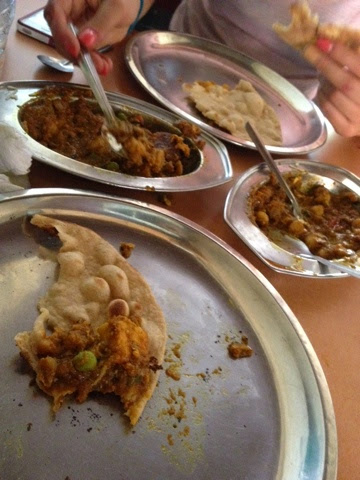
Thali was one of our favourite discoveries, and fast became a staple meal during our time in Rajahstan. Traditionally a South India dish, we actually had our best Thali's up north. Ranging from 70-300rps (depending on how classy the place and whether you opt for the fish, meat or veggie versions), Thalis usually consist of 2 roti, a poppadom and a small serving of steamed rice, these to accompany at least two curries, a Dahl, a portion of curd and occasionally a chutney. Eat with your hands and tuck in. 


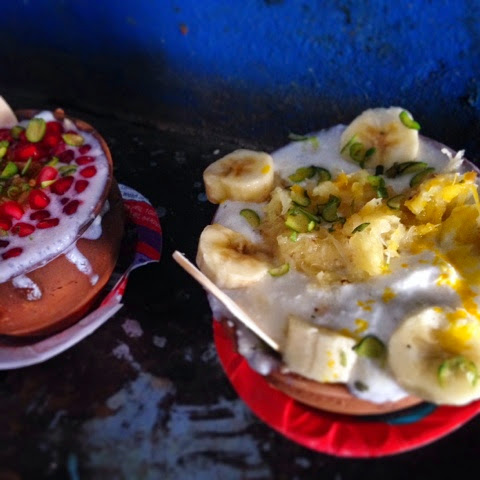
Lassis are curd based drinks that can be served salty, sweet or mixed with fruit. Ranging from 20-120rps depending on the place and the flavour combinations. Mango lassis are a firm favourite in India, but I'd always recommend going with the fruit in season. The best we had were from blue lassis in Varanasi (pictured), which was more like a yogurt than a drink, and Lassiwala in Jaipur which was served plain (sweet) in disposable clay pots. 


It was the recommendation of many to 'go veggie' during our time in India, and although some would argue that that was a shame as it meant we missed out on some foods, it wasn't an issue for us as the vegetarian food is so readily available, so varied and so tasty. We ate veg curries most days; ranging from the simple mix veg to the more adventurous malay kofta (an almond, potato and cauliflower kofta served in a creamy cashew sauce). Paneer is a soft cheese which makes an appearance in almost every veggie dish, and if you're a fan you should definitely try palak paneer (with spinach) and paneer masala. The cashew curries are also great and we has an excellent cashew and pineapple at laughing Buddha in Hampi. Be adventurous, the combinations are great.

A couple of translations:
Palak: spinach
Aloo: potato
Paneer: soft cheese
Gobi: cauliflower 
Mutter: beans
Chana: chickpeas


Chapati/ roti cost between 5-20rps and are eaten with almost every meal. Some have them instead of rice and others have them alongside. The simplest are plain, and are made with water and whole meal flour and cooked without fat making them the healthiest option. Parathas and naan can be stuffed with everything from potato to spinach to cheese and garlic. 

Chai is such an institution in India, and so quickly becomes part of your daily routine, that I almost didn't include it in this list. The sweet, milky spiced tea is served everywhere, and regularly offered a gift from shopkeepers, hoteliers and villagers alike. It's the perfect start to the day, but isn't for those who don't have a sweet tooth. The best we had was in the Shantaram slum in Mumbai for 6p. Amazing. 


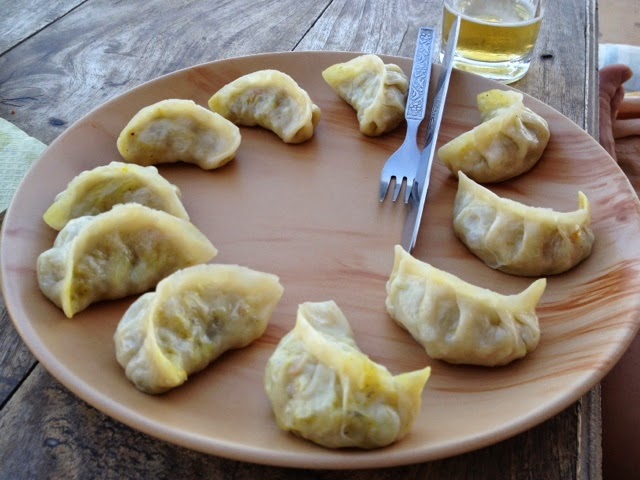
Momos are steamed buns which are very similar to gyoza. I preferred them with less spice as they reminded me of the Japanese snack from home. They're actually Tibetan, and can be filled with vegetables, chicken or fish. 


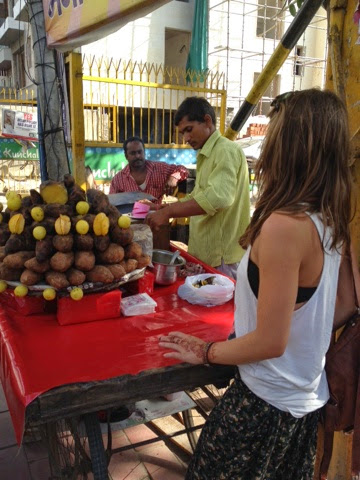
Shakarkandi are a steamed sweet potato street food that's native to Delhi. It's guilt-free too, which is always nice. Vendors chop the piping hot spuds onto a tapas-sized plate then douse it with lemon juice. It's then sprinkled with chaat masala which is a combo of black pepper, chilli, cumin, dried mango and sugar to name but a few. Only 20rps too. 


Petha is a traditional Indian sweet, native to Agra. It's made from white pumpkin and is similar to Turkish delight. We weren't the biggest fans; the texture was a bit strange. But for 50rps, when in Rome, right? 

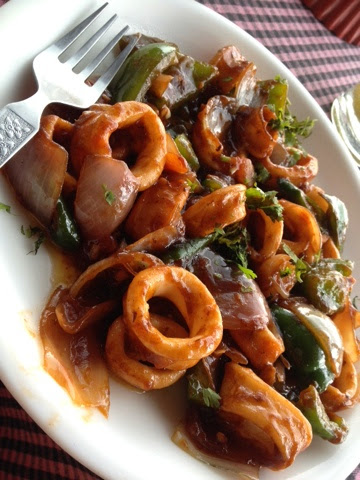
Manchurian's are popular across India and can be found on most menus that boast a multi-cuisine offering. Be it chicken, prawn, mushroom or another vegetable, the main ingredient is battered and deep fried then stir fried in a Chinese-style sauce with green peppers. 


Goa is the place to go for fresh seafood. Squid, shark, snapper; prawn, lobster or scallops: you can buy by the kilo, or opt for tandoor. Just keep an eye on the restaurant cleanliness as shellfish in particular is always a little risqué, even more so if you're trying to avoid Delhi belly. 

Bhel puri is a puffed rice street food at its most famous on Chowpatty beach in Mumbai. It's similar to Bombay mix, only 'wetter'. Puffed rice is mixed with peanuts, red onion, chilli, tomato, potato, fresh parsley and spices. Eat with your hands for a healthy (and spicy!) between meal snack. 

Friday, 17 October 2014

3 days in Hampi.

Where to stay?

Unbeknownst to us we arrived in Hampi in time for the Navarti festival season, which is an Indian holiday and therefore saw us join the thousands of tourists (both domestic and backpackers) who had chosen to descend upon the ancient town for the weekend. Almost every hotel  and guesthouse on the bazaar side of the river was full. We'd planned to cross the river and stay on the other side where alcohol is legal, but high tides stopped the boats for crossing. 


We met Will, a lone traveller from Virginia, at the bus station in Paniji and ended up sharing a room at Mayurums homestay for 1,200rps per night. Pricey, but the lowest we could wangle considering the holidays. Ravi, the owner, was more than obliging and the room was actually great, with a large bed, hot shower and good wifi. 

Netra guesthouse, on the edge of the bazaar, has cheap rooms and an awesome rooftop restaurant so that's defintaly worth a look.

On the other side of the river, the laughing Buddha is a hotspot that offers riverside bungalows for those willing to pay a little more.

If you're budgeting, head to sunny's guesthouse or further down the road to Shantis bungalows.

Exploring Hampi.

Day one we explored the town on foot and soaked up the infectious festival atmosphere. Ruins decorate your every line of sight in Hampi, there is no escaping them. Standing tall in the centre of it all is the Virupaksha temple with its intricate carvings and high walls. Cover yourself up if you visit, and expect to pay 20rps entry. Keep an eye out for Lakshmi, the temple elephant, who'll give you a happy slap on the head if you give her a few paper rupees (she wouldn't except coins, clever thing.) Monkeys are everywhere, adding to the 'raiders of the lost ark' feel about the place, and the place is full of people.


On foot you can explore the rock faces that border the town, littered with huge boulders and weathered temple ruins. Scale the stairs to theivandrum temple at the end of the road leading out of Hampi, it's worth it for the view. 


Day two we hired bicycles for 100rps each per day. Scooters are about 200-250rps, however we quite fancied the exercise. The roads are easy to navigate and by going it alone, without a tour guide, you're free to roam and take in as much or as little temple as you like. 


The underground shrine is definitely worth a look, but things do get a little touristy at the main site and you should expect to pay 250rps to enter the elephant stables. My advice? Go it alone, the landscape is unlike anywhere in the world and the surrounding villages are fascinating.


On our second night, the town lit 10,000 candles outside the Virupaksha temple, to mark the start of the Navarati celebrations. 


Family's dressed up in their finest clothes, with the women decorating themselves in highly embellished saris with bells round their ankles and flowers in their hair, and the men wearing crisp new Sherwani. We were honoured to be asked to get involved, and it was amazing standing amongst the candles and watching the procession, led by Lakshmi. 


Day three, the river crossing re-opened. The boat costs between 30-50rps (depending on the boatman...), and takes a matter of minutes. The other side is a little more chilled than the bazaar, alcohol is legal there and Bhang is readily available. We hired cycles again (50rps for the day) and went in search of the nearby lake. It's beautiful, and although the ride nearly killed us (over 5km, uphill, in the midday sun) it was worth the sweatfest.


Ignore the signs warning about crocodiles, they were put up to stop people swimming after a number of incidents in the dam. 


The water's safe and deep, too, making it perfect for cliff jumping. 

Star attraction...

Just be aware that you may quickly become the star attraction as word spreads around the nearby villages that westerners are jumping. There were about 20 pubescent males stood on the cliffs taking pictures by the time we took the plunge. 

We didn't get a chance to visit, but the monkey temple was highly recommended to us as a great place to view sunset on the other side of the river. 

Where to eat?

Netra guesthouse on the bazaar side is a backpackers hub, and serves great food at a reasonable price. The salads we're stand-out, with the 'funky monkey veggie salad' being my recommendation and a steal at 180rps. Breakfast is also good here, and the lazy bar layout makes it a great place to wile away the hours. You can get booze here too, despite the ban, just ask for the 'special' drinks. 

Netra restaurant 

Ravi rose will also get you beers, however you'll pay 250rps per can which is really quite expensive. Bhang lassis can also be bought at this rooftop, lazy restaurant. The food was tasty, with Thalis on offer and great stuffed partharas.

On the other side of the river, laughing Buddha is the place to be. Service is very slow, but drinks are readily available, the menu is vast, and the view is great. 

Chilling at the Laughing Buddha

And the rest...

We got massages at the Lotus salon, adjacent to Gantapi restaurant. A full hour, full body Ayurvedic, cost 600rps per person and was literally the best thing ever after a 12hour sleeper bus. 

Yoga classes are on offer at Gopi's guesthouse for 150rps each. 

I loved hampi and could have stayed for days. 3 is enough to see the place, but people linger here and it's clear to see why. You can just keep exploring.

L&A x